
Outside Faith
Searching for Meaning
Searching for Meaning ↴
Quick Links
Have a Question?
Searching for Meaning
7 of 7 Pages
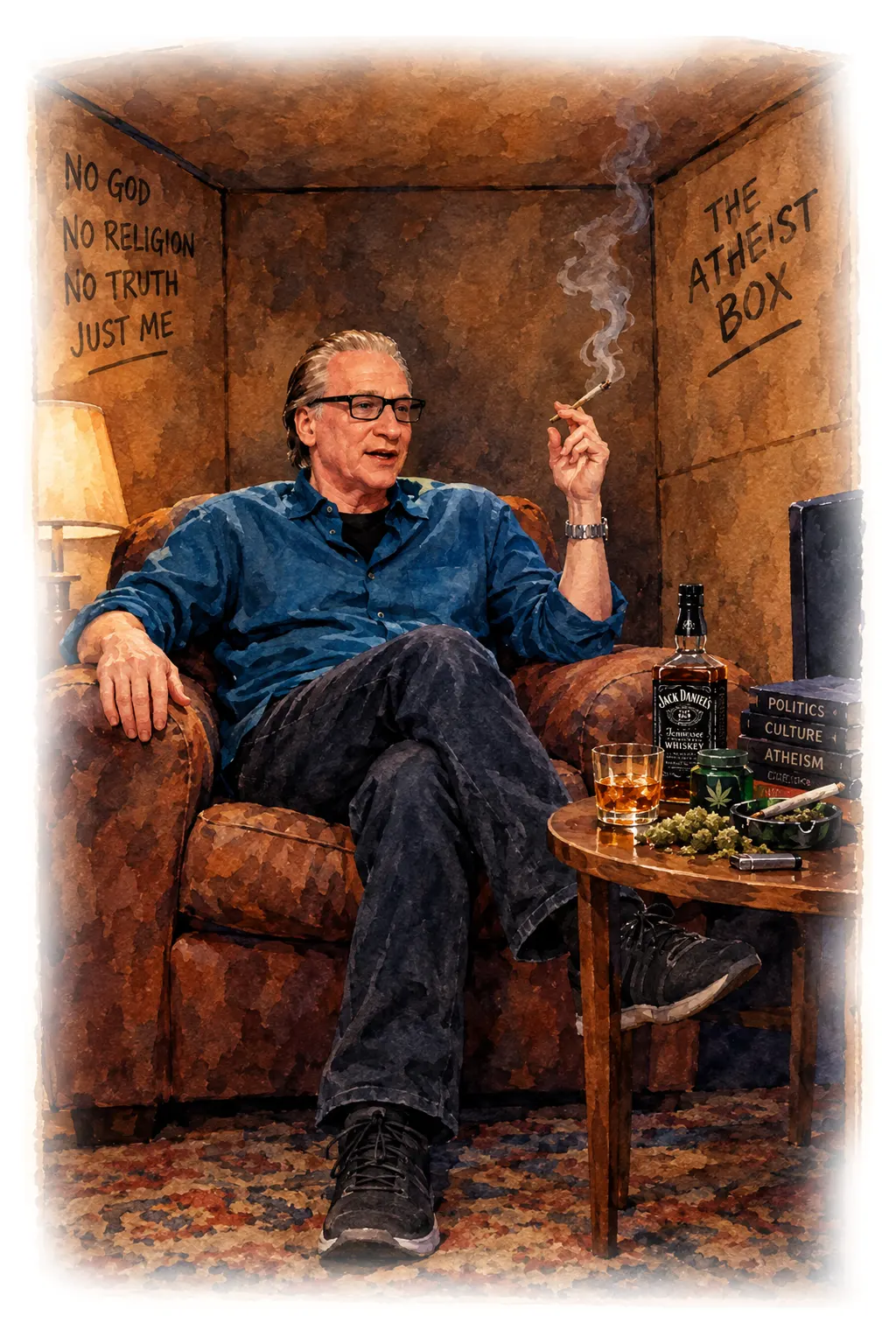
Bill Maher: The Man in the Box
When We Don't Care to Look Beyond What We Think We Know
The First Contradiction
I watched the movie Religulous with Bill Maher, and I also sometimes watch clips of his podcast on Youtube. In Religulous, Bill takes both a comedic and serious approach, talking with Christians, so-called Christians, and people of other faiths and beliefs in an attempt to examine why they believe what they believe. I, of course, am going to focus on his attacks on Christians.
Throughout much of the movie, Bill mocks, criticizes, and ridicules people for their beliefs, often making them appear foolish for believing in these things, especially God. He repeatedly gives the impression that believing in God is irrational and suggests that people somehow shut down a part of their brain in order to believe in a “man in the sky.” The message throughout the movie is pretty clear: believing in God is something he considers foolish.
I have also watched Bill on his podcast, where he has been even more direct about his position, stating that there is no God and that people who believe in God are stupid. So, based on what I have heard from him over the years, there doesn't seem to be much ambiguity about where he stands. He presents himself as someone who has concluded that God does not exist and that those who believe otherwise are simply believing in something that isn't there.
But this is where I found the first contradiction.
I watched the entire movie, and at the end, after all the mocking, ridiculing, and criticism of people for believing in God, Bill states that he is not sure whether there is a God or not.
Bill Maher reminds me of many atheists who debate, mock, and confidently state that there is no God, only to fall back on the defense that, in the end, they don’t actually know if there is a God. They stand on their soapbox and argue that God does not exist, but when challenged, they retreat to “we don’t know.” You can’t have it both ways. If you are going to make the claim that there is no God, then you are making a claim that requires justification, just as the person who claims that God does exist is making a claim.
Bill also seems to believe he is taking the higher road by saying that the atheist is simply willing to admit they don’t know. To him, that is the honest position, the truthful position, because no one can actually know whether God exists. Unlike the Christian, who refuses to say there is even a possibility that God does not exist. This seems to be what bothers Bill most. He sees the Christian’s position as being based on faith—blind faith, in his eyes. The Christian has no proof, he believes, only faith, and if faith is all they have, then the Christian should at least be willing to admit that they don’t know either.
Faith Misunderstood
Many people misunderstand the kind of faith that God requires of us. Sadly, even many so-called Christians fail to understand what biblical faith really means. When people read Scripture and see that we are to walk by faith and not by sight, they sometimes assume this means God never gives us evidence or proof, and that we are simply expected to believe without any reason or evidence at all.
“For we walk by faith, not by sight.”
But that is not what the Bible teaches. As Christians, we are told that God has given us evidence of His existence. Evidence can lead a person to consider that God exists, and by faith, that evidence can open the door to seeking Him. Then God steps into that person's life and makes Himself known. Faith is not simply believing in something with no basis for belief. It is trusting God in response to what He has revealed.
“The heavens declare the glory of God; and the firmament shows His handiwork.”
So, for the Christian, it is not simply faith without evidence or proof. There is evidence, there is faith, and there is the personal reality of knowing God. That is why a Christian can say they know there is a God without claiming that their knowledge came from blind faith alone.
“So then faith comes by hearing, and hearing by the word of God.”
It is much like marriage. When two people get married, they place their trust in one another. That trust is an act of faith. Neither person can know every detail of what the future will hold, but as they live together, each person has the opportunity to prove that the other’s trust was not misplaced. They can prove themselves to be faithful, loving, and caring—or, sadly, they can prove the opposite.
Our relationship with God is different in one important way: God proves Himself true. A Christian’s faith is not meant to remain nothing more than a blind assumption. As we come to know God, He reveals Himself and proves Himself faithful and true. Faith may be where the relationship begins, but it does not have to be where our knowledge ends.
“Oh, taste and see that the LORD is good; Blessed is the man who trusts in Him!”
For a Christian to say, “There may be a chance that there is no God,” would be more than simply admitting uncertainty. It would contradict the reality of having come to know Him. If someone claims to have been a Christian but ultimately says they have no idea whether God exists, that raises a different question: did they ever truly know God in the first place?
“And by this we know that we have known Him, if we keep His commandments.”
Man in the Box
Bill is a man in a box. He has boxed himself into a particular view of the world and, from inside that box, refuses to look beyond it. He says there is no point in looking outside the box because man cannot reach beyond it or prove what is outside of it. But that way of thinking can become a closed circle: if you refuse to look beyond the limits you have already established, then you will never discover whether there is anything beyond them.
Bill openly admits that he likes his box and the life he is living inside it. And I think this is important, because when a person is comfortable inside their box, they may not even recognize that they have closed themselves in. Instead of asking whether there might be something beyond what he can see, Bill seems to dismiss the question altogether. Why even look for God if we cannot reach outside the box?
“The fool has said in his heart, ‘There is no God.’”
I think that is where the deeper issue lies. It is not simply that Bill believes there is no God; it is that he seems unwilling to leave open the possibility that there could be one. I believe this may be because he does not want to know the truth if the truth would require him to leave the life he is comfortable living. He is happy in his box.
Bill argues that Christians invented God because they needed an answer, something that would make them feel better about their lives and give them a sense of purpose. But there is another possibility that he does not seem willing to consider: perhaps he has done something similar in reverse. Perhaps he has denied the existence of God, not because he has proven that God does not exist, but because doing so allows him to remain comfortably inside his box.
“And this is the condemnation, that the light has come into the world, and men loved darkness rather than light, because their deeds were evil.”
The Christian says, “There is a God, and I have come to know Him.” Bill says, “There is no God, and there is no reason to look outside the box.” Both are making claims about what lies beyond the limits of what we can see. The question is not simply who is more comfortable admitting they do not know. The question is whether we are willing to step outside the box and honestly seek the truth, wherever that truth may lead.
“And you will seek Me and find Me, when you search for Me with all your heart.”
Let Go to Discover Truth
When we were small children, most of us looked up to our parents and believed they had it all together. We thought they knew so much more than we did and had the answers to just about everything. Then we grew up and began to discover that our parents were not as perfect as we once imagined. They made mistakes, they sometimes lied, they didn’t always know what to do, and we realized they didn’t have everything figured out after all. At some point, many of us began to believe that we were different—that we had the answers, that we understood life, and that we knew what we were doing. Then life has a way of humbling us, and we discover that we don’t have the answers either.
“For the foolishness of God is wiser than men, and the weakness of God is stronger than men.”
Bill is correct about one thing: there are limits to what we, as human beings, can know. We cannot simply reach beyond those limits and figure out the ultimate answers to life on our own. But instead of seeing that as a reason to stop searching, perhaps it should humble us. If we cannot answer the biggest questions of life—Why are we here? Where did we come from? Why do we exist? What happens when this life ends?—then perhaps that should make us consider that there is something greater than us that can answer them.
“Such knowledge is too wonderful for me; It is high, I cannot attain it.”
That is where God comes in. The beauty of God is that we do not have to reach beyond our limitations to find Him. He comes to us. We cannot climb high enough, think deeply enough, or search far enough to discover God on our own, but God can reveal Himself to us if we are willing to open the door by faith.
“Behold, I stand at the door and knock. If anyone hears My voice and opens the door, I will come in to him and dine with him, and he with Me.”
Perhaps that is what we need to do: let go of the certainty that our little box contains everything there is to know. Lift the lid. Look beyond the walls we have built around ourselves and see what might be waiting outside. Because if we are willing to admit that this boxed-in life cannot provide all the answers, then perhaps we should be willing to look beyond the box and consider the possibility that the answer is there waiting for us.
“Ask, and it will be given to you; seek, and you will find; knock, and it will be opened to you.”