
True Life
What does it mean to live a true life—to live beyond survival, beyond the fleeting and the temporary; to live the life God created us to live?
Searching for Meaning? You’re Not Alone.
The Search For Answers
There comes a moment when everything we build, chase, and hold onto begins to feel incomplete, and we start asking deeper questions—Why am I here? What is all this for? We search for meaning in success, relationships, identity, and purpose. For a moment, it can feel like we’ve found it, but eventually, something still feels missing—because meaning was never meant to be created by us; it was meant to be found in the One who created us.
This site is a path toward understanding what life really is, why the world feels empty without God, who God truly is, and how we can come back to Him. While the world offers temporary meaning, God offers eternal life—a life filled with purpose, truth, and love that does not fade. If you’ve ever felt disconnected, empty, or like something is missing, you are not alone, and you are not without hope.
The Way Home
We were made by God. He is our Creator, Father, Lord, and King. God is life, love, and truth—the very source of all life. Yet we rejected Him and became orphans, runaways, prodigals, like a branch disconnected from its vine. Separated from Him, we became disconnected from life, truth, and love itself. We searched for these things within ourselves, in the world, and in others, but they cannot truly be found there apart from God. Because He made us, we are capable of thinking, loving, and longing for meaning, yet without Him we cannot fulfill these things rightly, for we were made to live by Him.
There is a heart within all of us that wants to live for ourselves. This desire caused us to reject God. Through our sin, we create rebellion, join the rebellion of others, and lead others into rebellion as well—against God, truth, love, and all that is holy. In doing so, we corrupted God’s design for life and exchanged it for a cancerous way of living that spreads decay, division, and death through all creation.
The evidence of our disconnection from God is seen in the unrest within us all. We cannot find peace with one another, nor can we find peace within ourselves. We seek from ourselves and from others what only God can give, and the result is sin, division, conflict, wars, and death. We are branches disconnected from the vine; sin courses through us, causing us to wither, and that withering reveals our inevitable death.
God has done everything to pursue us and invite us back home. Through His Word, through the prophets, the saints of old, and through His chosen people, Israel, He continually reached out to us. Then Jesus came into the midst of our broken world and revealed the kingdom of God through His life, love, grace, and truth. He lived the perfect life we could never live, bore the penalty for our sins against the Father, and made a way for us to return home to God. Jesus invites us to come home to the Father through Him.
The story we have written with our lives—the record of all our sins against the Father and against one another—will be taken upon Jesus. In exchange, the perfect and sinless life that Jesus lived will be credited to us. God promises that if we believe in what Jesus has done, repent, and turn toward Him, we will be welcomed into His family. Through Christ, the door home is opened, and He Himself leads us back to the Father. God promises us a new heart and gives us His Spirit to help us, so that we will no longer remain lost in rebellion. We are sealed by the Spirit and sustained by Jesus Christ to the very end, until we enter our final glory with God in Heaven.
The choice now is ours: to keep seeking life in this world and within ourselves, or to return home to the Father and find true life.
Read MoreA search for God in a world filled with confusion.
After decades of searching for the meaning of life and whether God exists, I had to ask myself: why would I look to humanity—including myself—for the final answer? If my soul is truly at stake, why would I place my trust in people who are limited, broken, and easily deceived?
As human beings, we often make decisions through the lens of our desires, misconceptions, wounds, pride, and limited understanding. Our perspective is small, and our judgment is flawed. So why would I place my life in the hands of what is finite when I could place it in the hands of the One who is infinite?
If we rely on the broken world as our ultimate authority, we will eventually fall into deception. The world is divided, confused, and, as Scripture says, under the influence of the enemy. Just look at what the world produces apart from God: hatred, greed, pride, corruption, emptiness, division, violence, and endless confusion. Why would I trust a fallen world to give me the answer to eternal life?
Take a single day on social media or YouTube and search for anything about Christianity, God, or religion, and you can quickly fall into a rabbit hole that pulls you deeper and deeper. Debates rage back and forth. People claim to explain the Bible with certainty, while others contradict them with equal confidence. Many are chasing views, subscribers, and attention, so sensationalism often takes the place of truth.
And it does not stop there. According to the Center for the Study of Global Christianity, there are an estimated 45,000 to 49,000 Christian denominations worldwide. There are countless theologians, apologists, and historians people look to for answers—men like James the Just, Polycarp, Ignatius of Antioch, Thomas Aquinas, C. S. Lewis, Martin Luther, and John Newton. Add to this the countless beliefs and religions in the world, and many people are left asking: What is a person supposed to believe?
Everywhere you look, people argue back and forth—sometimes angrily, sometimes sarcastically, sometimes stubbornly. Many speak in ways the average person can barely understand, using what feels like a different language entirely—what I call “Christianese.” At times, it no longer seems like the goal is to help people find faith or truth, but to prove who is smarter or more knowledgeable. You can even see it in the titles of videos: “So-and-so destroys so-and-so,” as if faith has become less about seeking God and more about winning arguments. There are two problems that have arisen from what I have noticed.
Debates and knowledge are important, but somewhere along the way, they became the priority. I do not know which came first—people wanting to be convinced through intellectual arguments, or Christians believing they could convince others primarily through knowledge—but faith was never meant to rest on knowledge alone. God has called us to more than simply winning arguments or proving points.
Yes, people have come to faith through intellectual understanding. But people have also come to faith through something as simple as a church pizza party. That does not mean either should become the center of Christianity. Knowledge by itself is not enough. Satan has knowledge. The demons know who God is, yet their knowledge did not lead them to love or follow Him—it led them to rebellion.
Even Paul the Apostle was once a deeply studied man of Scripture, yet his knowledge led him to persecute Christians before his encounter with Christ. Nicodemus was also highly educated in Scripture, yet his learning led him into religious tradition to the point that Jesus told him he must be “born again.” Knowledge can inform a person, but it cannot by itself transform the heart.
Scripture also makes clear that arguments alone are not the clearest witness to God. Jesus emphasized transformed lives, love, holiness, humility, and obedience as evidence of God’s reality and work.
Jesus said:
“By this all people will know that you are my disciples, if you have love for one another.” — Gospel of John 13:35
And:
“You will recognize them by their fruits.” — Gospel of Matthew 7:16
Several biblical warnings:
1 Corinthians says:
“Knowledge puffs up, but love builds up.”
And Epistle of James strongly criticizes a faith that exists mainly in words without visible action.
We are called to preach the Word and to know the Word; those things matter deeply. But we are also called to live the Word. God called us to be salt and light, to bear fruit, and to love one another through His love working in us.
When we truly live like Christ—when we forgive, remain humble, live content, seek first the Kingdom instead of the world, and stand fearless even when everything around us is falling apart—people take notice. That is when our words become more than words. That is when Christ is seen within us. And when people see Him in us, what we say begins to carry weight.
This is the power of God on display: not merely argued about, but lived out.
We are living in a world where the light of Christ is growing dim. Many Christians have compromised the call to be fully surrendered to Him, believing that people can mainly be won through arguments, debates, and knowledge alone. But endless information does not always lead people to the truth. In fact, I once heard it said that the easiest way to keep people from the truth is not to hide it, but to drown it in endless noise and information. That is exactly what the enemy has done.
The voice of God is being buried beneath countless opinions, arguments, distractions, and confusion. Yet none of that changes the truth itself. You and I must stop looking to the world for answers only God can give. That is the very cycle the enemy wants us trapped in—a never-ending circle of confusion, human reasoning, and broken understanding. Instead, we must go to the One who can truly answer us: God Himself.
God will answer the person who genuinely wants to know the truth. But that raises the real question: do we truly want the truth, even if it costs us our pride, our desires, our worldview, or our control?
The message of the Bible has always pointed to the same reality: humanity cannot save itself by living for itself. True life is found only in God. But to receive that life, a person must be willing to surrender—to stop placing ultimate trust in themselves, in the world, or in other people, and instead place everything into God’s hands. It is often there, in surrender, that God begins to reveal Himself.
Knowledge of God’s Word is vital, but it is truly understood only when the Spirit brings it to life within us. And when that truth becomes alive in a person, the world can see its power. This happens not merely through human understanding, but through Jesus Himself—convincing us, transforming us, and revealing the truth to us.
You want knowledge, and God desires that you grow in knowledge. But in the end, we are meant to reason with Him—so that we come to know and embrace the truth as it truly is.
The Christian Mission—The Battle Between Self and Surrender
There is something within me—and within all of us—that stands opposed to God. Whatever stands opposed to God is evil, and every human being carries it. This is part of why the nonbeliever rejects God, and part of why even the Christian struggles to live the abundant life Christ speaks of. If you do not believe me, consider this.
In the Gospel of John 15:5, Jesus says: “I am the vine; you are the branches. Whoever abides in me and I in him bears much fruit, for apart from me you can do nothing.”
In simple terms, this passage is telling us that our lives are meant to be about God.
And what that means is this: a branch cannot live apart from the vine. It is not designed to. In the same way, we are not designed to live apart from God. God did not come to us so that He could simply be part of our lives, nor did He come merely to invite us to be part of His as an addition. He came so that we could have life—because He is life.
So as a branch lives from the vine, we are to live from God. We are to live for Him. To glorify Him through submission, through turning from sin, through obedience, and through following His commands. Apart from Him, we can do nothing. Apart from Him, the branch dies. We are to be about God.
And when I say “rooted,” I mean saved. We do not do these things in order to be saved—we do them because we have been saved.
God is not something we place at the top of a list of priorities. We ourselves, apart from God, are not even on the list in the way we tend to think. We are called to deny ourselves completely and to live by His Spirit, not our own. To abandon independence. To live fully dependent on God. To live for Him, by His ways, under His leading, for His glory.
God’s Word was not given merely so we could learn how to live our “best life.” It was not written simply to make us more successful, more fulfilled, or even just better spouses, parents, friends, or people. And while following God’s wisdom does shape those areas, that is not the ultimate purpose of Scripture.
The Bible was not given so life could stay centered on us while God helps improve it from the side. It was given to show us that God Himself is better, sufficient, and worthy of our entire lives.
There are people who may outwardly prosper by following principles found in Scripture, yet still remain far from God. So the goal of Scripture is not simply moral improvement or a better life. It is reconciliation with God Himself.
The Bible was written so that we would come to know God, walk with God, follow God, and be about God. It teaches us to live in His ways so that every part of our lives points back to Him and brings Him glory.
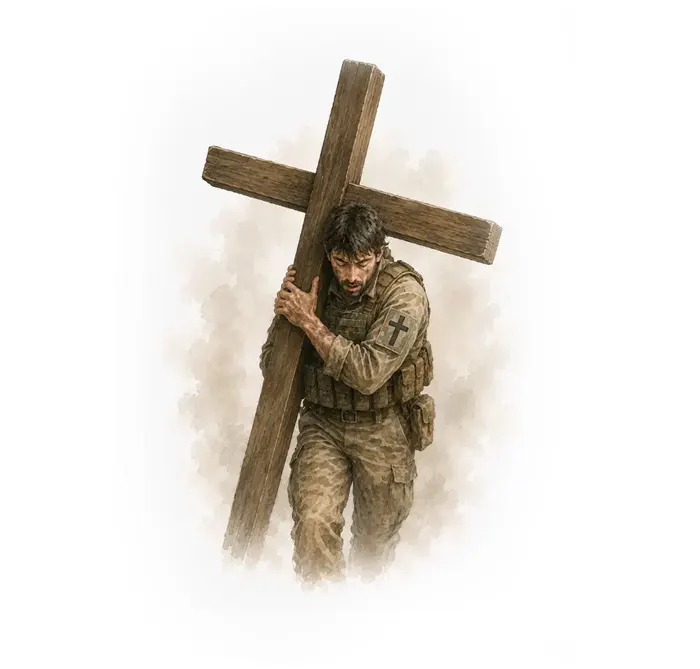
Throughout Scripture, we are repeatedly shown that the Christian life is a kind of battle. Paul uses this language often. In Second Timothy 2:3–4, in Ephesians 6:11–17, in Philippians 2:25, and in Second Corinthians 10:3–5, we see the imagery of warfare used to describe what it means to follow Christ.
And a soldier—if he truly believes in the cause he serves—does not live centered on himself. He sets aside personal life: desires, preferences, opinions, ambitions, even comfort. He allows himself to be trained, shaped, and disciplined for the mission before him. He learns to submit, to follow orders, and to trust his commanding authority. He no longer directs his own steps, but yields himself to the purpose he has committed to serve.
In the same way, if a Christian truly believes in God, they are willing to set aside their personal life—desires, preferences, opinions, ambitions, even comfort. They are willing to be shaped, pruned, and trained by God in the disciplines of faith. They learn to submit, to follow, to trust God’s authority. They stop directing their own steps and begin yielding themselves fully to His purpose.
The soldier must be all about the mission.
And what many do not realize is that being God’s “soldier,” in this sense, is one of the ways He forms us into the image of Christ. And if we are being formed into the image of Christ, then we are being formed into who we were truly created to be—people who reflect God in character, love, and purpose.
From that place, we do not lose ourselves. We become what we were meant to be. We grow into better sons, daughters, parents, friends, and people—not by centering everything on ourselves, but by centering our lives on Him. That is the direction that leads to true life, regardless of what this world brings.
A soldier who is focused on the mission, disciplined in training, attentive to instruction, and committed to obedience becomes effective and strong. But a soldier in the middle of battle who becomes focused on himself instead of the mission becomes vulnerable. He becomes easily overcome. He becomes a casualty of distraction. In the same way, many Christians struggle because they remain focused on themselves instead of fully stepping into the call of belonging to God.
In the end, the call of the Christian is to give God all the glory and to live wholly for Him with everything we are. Our opinions, ideas, thoughts, desires, and longings are meant to be laid down before Him in exchange for His will and His way.
Yet this is where something within us resists. Because surrender can feel like loss. It can feel like we are becoming less important—as if our lives no longer matter, not even in the background.
And so we begin to resist that idea.
We begin to want a version of faith where God affirms our desires, validates our plans, and supports our sense of control. We want to feel that we still hold the steering wheel, even if God is present beside us.
But there lies the tension. Because the truth is, we do not hold that place.
Anything we build apart from God cannot hold the weight of what we are trying to make it. And anything that pulls us away from Him pulls us away from the life we were created for.
So ask yourself this: if God is truly God—omniscient, omnipotent, omnipresent, fully sufficient, perfectly wise, and full of love—then what exactly do we lack in Him?
What could we add to Him that He does not already possess?
What insight could we offer that He has not already known from eternity?
What place do our opinions hold before perfect wisdom?
It is like someone with no understanding of painting or music standing before a master and insisting they can improve the lesson. It does not elevate the student—it only reveals misunderstanding. In the same way, what do we think we can add to God?
And so the question remains.
Can you accept this reality?
Can you lay down yourself—your plans, your desires, your control—and give it all to Him?
Can you give Him all the glory in every part of your life?
What Evil Reveals About God and Ourselves
Many people who deny the existence of God point to the evil and suffering in the world as evidence against Him. If God is loving, moral, and all-powerful, why is there so much suffering? Why do people die, some enduring terrible pain from disease, violence, or tragedy? Why do innocent children suffer? Why do animals experience fear, pain, and violent deaths? These are difficult questions, and for many, they become a reason to doubt that God exists at all.
Remember, God is seeking to awaken us and mature us because He loves us. He wants us to see that true life is found only in Him, for apart from Him there is no life—only death.
According to the Bible, humanity rejected God. We turned away from perfection, holiness, and life itself because we desired autonomy and independence. Yet in choosing separation from God, we brought sin and death into the world. Perhaps physical death is one consequence of that rebellion. Death reminds us that our lives are temporary, shattering the illusion that we are self-sufficient or that we can somehow live forever apart from our Creator.
Why do young children die? Death is no respecter of persons. It confronts every one of us with the reality that our time is not guaranteed and that eternity is closer than we often imagine.
Why do people suffer before they die? Suffering is one of the bitter fruits of a fallen world—a world damaged by sin and estranged from the God who is life. It reminds us of the terrible cost of humanity's attempt to live independently of Him.
Why do animals suffer and die? This, too, is a consequence of humanity's fall. Scripture teaches that creation itself was subjected to corruption because of sin. Death entered not only human experience but the world itself.
In the Old Testament, God commanded animal sacrifices to teach us the gravity of sin. Every sacrifice was a reminder that rebellion against God brings death. Those sacrifices pointed forward to the ultimate sacrifice that would one day be made—Jesus Christ Himself. The innocent would die for the guilty.
We brought the cancer of sin into the world, yet we often question why that cancer produces so much suffering and death. Sin is not a small mistake; it is a corruption so severe that it ultimately required the death of the Son of God. The cross reveals both the seriousness of our rebellion and the depth of God's love.
If God Himself stepped into our world and took the punishment we deserved, should we not pause before questioning the severity of sin's consequences? The very punishment we question is one that God was willing to bear Himself.
People love to ask, "If there is a loving God, why is there evil in the world? Why doesn't He do something about it?" Yet I often find that those who blame God for the world's darkness are unwilling to confront the source of that darkness honestly.
To claim that God is responsible for all the evil in the world is to ignore the obvious. Jesus entered the world teaching love, forgiveness, humility, self-sacrifice, and mercy. He taught us to turn the other cheek, to love our enemies, and to put others before ourselves. There was nothing evil in His words, His actions, or His life. In fact, if humanity truly lived according to His teachings, much of the suffering we see around us would disappear.
But that is precisely the problem—we don't want His way. We have rejected it. We have rejected the very thing that could unite us in love, peace, and selflessness. We reject God and then act surprised when the world reflects the consequences of that rejection.
Who are we trying to convince that evil does not come from us?
Every institution, every ideology, every government, every movement, and every belief system eventually becomes corrupted by human pride, greed, selfishness, and the hunger for power. Humanity struggles to live at peace with its neighbors. Many of us cannot even live in peace within ourselves.
Remove God from the equation for a moment and ask a simple question: Where does evil come from?
Children starve to death while others waste more than they could ever consume. People abuse, exploit, and murder one another. Neighbors hate each other. Animals are mistreated. Wars are started. Lies are told. The evil committed by human beings can become so destructive that societies build prisons simply to protect themselves from them.
Yet when God speaks of separating evil from His kingdom, many become offended.
The truth is that sin, suffering, and death point to a guilty party—and it is not God. It is us.
But that is the problem, isn't it? We do not want to point the finger at the real criminal. We would rather point at God—even while claiming He does not exist.
Think about the contradiction. If God does not exist, then He cannot be blamed for the world's evil. Humanity stands alone before the evidence. But if God does exist, He warned us from the beginning what would happen when we rejected Him. The violence, corruption, hatred, and death we see are not a surprise to God; they are the fruit of humanity choosing its own way.
Some will respond, "It is not God that causes the problem, but belief in God."
Really?
Did God's teachings create greed, selfishness, hatred, murder, rape, exploitation, and abuse? Did God's commands create starvation, homelessness, corruption, and war? Are these things the product of Christ's command to love your neighbor as yourself?
Or are these things the product of the human heart?
And while we accuse God, what are we doing? Are we feeding the hungry? Caring for the suffering? Protecting the vulnerable? Loving our enemies? Or are we sitting comfortably, watching the world burn, while pointing an accusing finger toward a God we claim does not even exist?
The reality is that we do not want to admit the evil within us.
We insist that humanity is fundamentally good, yet every century of history tells a different story. A blind man can see that our goodness has not been enough to create a world of peace. The evidence is all around us.
The answer to evil is not less accountability. It is not the removal of God. For when God is removed as the highest authority, something else inevitably takes His place. History has repeatedly shown that when human beings become the ultimate authority, power becomes its own god, and people suffer under it.
The world is not drowning because God has failed humanity. The world is drowning because humanity has rejected God, rejected His ways, and then blamed Him for the consequences.
The cross itself is proof of this. When God entered His own creation, humanity did not crown Him—we crucified Him. Yet even then, He responded with mercy and forgiveness.
The greatest evidence of what is wrong with the world is not God.
It is us.
I do not claim to have all the knowledge necessary to explain every reason God allows evil and suffering in the world. I am not God, and there are questions that reach beyond the limits of my understanding. What I do believe is that suffering exposes the truth about who we are and who God is. It strips away our illusions of self-sufficiency and confronts us with realities we would rather avoid.
Yet no answer I give will ever fully satisfy the skeptic, because the problem is not merely intellectual. If God Himself is the answer, then no explanation apart from Him will ever be enough. The demand is often for an answer that can be accepted without submitting to the One who gives it.
At some point, we must acknowledge the limits of our perspective. A child does not always understand why a loving parent says no, permits hardship, or allows painful circumstances. The child sees only a small part of the picture, while the parent sees far more. How much greater is the gap between finite human beings and an infinite God?
The reality is that there are questions only God can answer. But if we refuse to listen to Him, we should not be surprised that those answers remain out of reach.
In the end, the deepest question is not, "Why does God allow suffering?" The deepest question is, "Whose authority will I trust?" Will I place myself on the throne as the final judge of reality, deciding what God must do before I will acknowledge Him? Or will I humble myself before the One whose wisdom exceeds my own?
That is the question every one of us must answer. Not whether God will answer us, but whether we will answer to Him.
This world will end for all of us. The evil and suffering that surround us today do not have to be our eternal future. The question is whether we will humble ourselves and surrender to the One who alone can save us from it.
In the end, the issue is not God's authority over us. The issue is whether we are willing to acknowledge it.
Featured Text of the Month
Failure is not the greatest danger. Succeeding without God is.
As you reflect on your life, have you ever felt like you’ve come up short—unable to find meaning, purpose, success, love, or lasting joy? Maybe you’ve experienced moments of achievement, yet still carried a quiet sense that something essential was missing. Or perhaps it feels more severe: as though your life has become a series of missteps, leaving you with the belief that nothing can be repaired and nothing ever truly went right.
What may weigh heaviest is the fear that it’s simply too late—that too much time has passed, too much has been broken, and if clarity or fulfillment hasn’t come by now, it never will. Then you look at others who seem to have what you lack: stability, relationships, success, comfort, a life that appears whole. And the contrast deepens the feeling that you’re on the outside looking in—disconnected, out of place, and unsure whether you ever truly belonged at all.
The first thing you need to realize is that you are not alone. Almost everyone on this earth has felt this way or will feel this way at some point, though few are willing to admit it. Many of us stubbornly believe we will eventually figure it out—that given enough time, we will get it right. “Give me time, I’ll work it out,” we tell ourselves. We think that if we turn over every stone, walk every path, and seek counsel from enough people, we will eventually find the answer. We search for it within ourselves, in others, and in the world around us, hoping something will finally satisfy that inner longing. And then there are those who come to the conclusion that they never will—that they are too far gone, too broken, or too much of a failure for there to be any real hope for them.
Remember the song, “Looking for love in all the wrong places”? The deeper problem is that we have been looking in all the wrong places. If we are not seeking God as the foundation of life—our meaning, our purpose—we are not looking where life is actually found. It is not too late to turn back. Yes, you may feel as though you have made a mess of things behind you, but as long as there is life, there is still time to find the truth. And when you do find Him, even the regrets, failures, and broken pieces of your past will begin to take on meaning. You will come to see that even what was painful and broken was not beyond redemption, but part of the journey that led you to realize that true life and meaning are found only in God. Grace can outlive our regrets.
Those who believe they have found meaning apart from God concern me the most. What many call fulfillment apart from God is often only spiritual starvation hidden beneath temporary satisfaction. The world offers substitutes that feel satisfying but cannot satisfy: success, relationships, pleasure, and endless distraction. In this condition, even people can become means to an end—used to affirm identity, soothe insecurity, or fill emotional emptiness rather than being loved as persons made in the image of God. What looks like fulfillment is often just self-deception, temporary relief that masks a deeper void. These are placebos for the soul, unable to carry the weight of what we were created for.
“What does it profit a man to gain the whole world and lose his soul?” That is the question God asks. A person may spend their entire life building wealth, success, reputation, relationships, or comfort, yet still fail at the most important thing of all. To build a life while neglecting the very reason you were created is the greatest tragedy imaginable.
What value is there in everything we achieve—whether triumph or failure, pleasure or pain, success or regret—if we miss the very purpose of our existence? It is like climbing a mountain, convinced there is treasure at the top, only to arrive and discover there is nothing there. It is like studying your whole life for a final test, only to fail the one exam that truly mattered.
The purpose of life is not merely to succeed on earth, but to find the treasure that remains long after this life is over. It is not to spend your years gathering what cannot last, but to receive what can never be taken away. And that treasure is available no matter who you are, what you have done, or where you find yourself today.
Jesus Christ is calling, waiting, knocking. All that remains is for you to believe in Him and trust Him. In Him, you will find the answer you have been searching for all along. You will discover why you were created. Your eyes will open to the truth. You will cross the finish line and receive the prize that truly matters.
You may have stumbled through many of life’s tests on this earth, but through Christ, you will have passed the test that lasts for eternity.
Read More
A liar, a lunatic, a good teacher… or God?
There is strong historical evidence that Jesus Christ existed, coming from multiple sources—both Christian and non-Christian. Historians across the spectrum, including many secular scholars, widely agree that Jesus of Nazareth was a real historical person who lived in the first century.
So the question is not whether He existed...
Read More
Discover the Gospel from a perspective you may have never considered before.
What does it mean to live a true life—to live beyond survival, beyond the fleeting and the temporary; to live the life God created us to live?
Explore the gospel more deeply—examining its different dimensions and what they reveal about God, humanity, and salvation.
Being a Christian means more than belief—it’s about truly knowing, faithfully following, and wholeheartedly living the truth of the faith each day.
By what means does God build His church, and what role has He given us in that work? Have we failed to play our part?
Exploring why many see faith as irrational—inviting honest, respectful dialogue without fear or judgment.
Devotional words to draw you closer to God and bring rest to a weary soul—meant to inspire, reflect, and renew.
Reflect and meditate on God’s Word through a simple, layperson’s study focused on its moral lessons.
Listen and reflect on sermon messages that help bring the truth of God’s Word to life.
A collection of Christian links, books, and tools designed to encourage, educate, and strengthen people in their faith.