The Question of a Lifetime
The Truth is Beyond this World
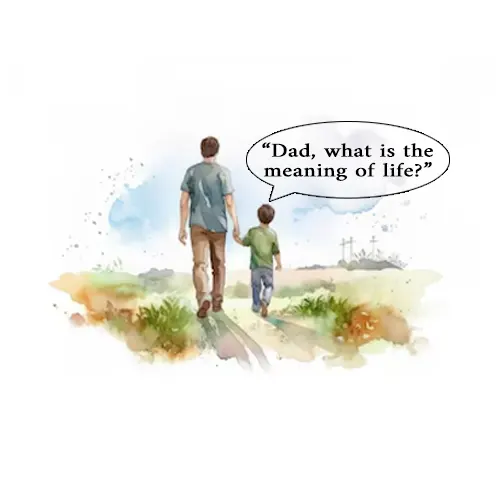
What are we teaching others to follow?
Imagine a young child you love—your own, a nephew, or a dear friend’s child—coming up to you with honest, searching eyes and asking:
“What is the meaning of life? Is there a God? What should I live for?”
How would you answer them? What path would you point them toward?
How do you define the meaning of life?
Many people don’t realize how deeply they’ve been shaped by the world around them. They move through life assuming what they are doing is meaningful—until they are asked that simple question: “What is the meaning of life?” And suddenly, uncertainty rises. (Romans 12:2)
I’ve heard people say they believe in God simply because they were raised that way. Others reject Him because of the hypocrisy they’ve seen in those who claimed to follow Him. In both cases, their beliefs were largely shaped by others.
But if we truly care about truth—if we truly care about the people we love—there comes a point where we can’t let others decide for us. The same voices shaping our answers may themselves be following someone else’s definition.
At some point, we have to step back, set those influences aside, and take responsibility for our own lives—to search, to wrestle, and to discover for ourselves what the meaning of life truly is. (Jeremiah 29:13)
Most children aren’t asking these deep questions—but they are quietly watching you for the answers.
They observe what you believe, what you prioritize, and how you live. Over time, that witness shapes them. If your life appears compelling and genuine, they may be drawn to follow the same path. If it feels empty, inconsistent, or unconvincing, they may reject it—sometimes running in the opposite direction altogether.
The path you walk is never yours alone. To them, it becomes either an invitation to follow or a reason to turn away. (Deuteronomy 6:6–7)
For those of us who have found the meaning of life in God, it should be our deepest desire to point others to that path—not only with our words, but with the way we live. (Matthew 5:16)
But there is a tension here, even when our hearts are sincere.
If you’re anything like me, you didn’t come to God untouched. Years without Him formed habits, shaped wrong thinking, and led to actions that do not simply disappear after salvation. Even now, there is a real struggle within—a wrestling between the old life and the new. (Galatians 5:17)
And our children see that.
They see the struggle. They notice the compromises, the inconsistencies, the moments where belief and action don’t align. I can explain the battle to them, but they won’t fully understand it until they face it themselves. What they often see, at face value, is a man who says he loves Jesus with all his heart—and yet still lives in contradiction.
It would be easy to excuse this by saying they must work out their own salvation. But that does not remove the weight of what God has entrusted to us. (Philippians 2:12)
We are called to be light and salt—to bear His fruit before a watching world. That is a real responsibility: to pursue a faith that is not only spoken, but seen. Not perfect, but sincere. Not without struggle, but marked by repentance, growth, and visible devotion that testifies—through both failure and faithfulness—that God is real, God is good, and He is worth following. (Matthew 5:13–16; John 15:8)
"Before you teach others what to live for,
you must first decide it for yourself."
For those who are young, my encouragement is this: seek the answer to life’s deepest questions for yourself—What is the meaning of life? Is there a God?—so that your life is built on something you truly understand and believe. (Proverbs 4:7)
Don’t wait until you’ve gone too far down a path or built your life on foundations you’ve never examined. The longer you wait, the harder it becomes to let go of what is false and embrace what is true.
Search early. Wrestle honestly. Build carefully—so that when you find the truth, your hands are free to hold onto it.
For those who have found the truth—that God is the meaning of life and the One we are called to live for—then live it with all your heart, mind, and soul. (Deuteronomy 6:5; Matthew 22:37)
We will stumble. We will fall. But we must not compromise, excuse what we know is wrong, or shift responsibility away from ourselves. That is not the life of faith. (1 John 1:8–9)
Truth and love do not bend to convenience or self-deception. They are not adjusted to fit our weaknesses—they remain, and we are called to align our lives with them. (John 14:6)
If we truly love our children and love others, then our deepest desire should be to point them to the One we claim to love. And if we say that Jesus is life, then our lives should reflect that reality. (Colossians 3:17)
So seek Him with all your heart. And as we do, we trust that everything else will be added in its time. (Matthew 6:33)